

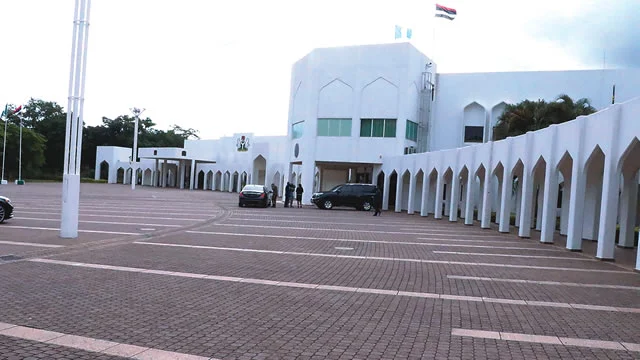
The Aso Rock Presidential Villa in Abuja will disconnect from the national electricity grid by March 2026 as part of a shift to solar power.
CLICK THE LINK TO READ FULL LIST
CLICK THE LINK TO READ FULL LIST
The State House Permanent Secretary, Temitope Fashedemi, disclosed this on Wednesday while presenting the 2026 budget before the Senate Committee on Special Duties at the National Assembly.
He explained that the solar mini-grid project, completed late in 2025, has been under testing since December and is expected to become fully operational in the coming weeks.
According to him, the changeover to solar energy will reduce the cost of electricity at the Villa. He pointed to the State House Medical Centre as an example, stating that the facility has run on solar power since May 2025 without using its generator.
He added that only a small portion of electricity was drawn from the Abuja Electricity Distribution Company within that period, while most of the supply came from solar panels supported by battery storage.
The Federal Government approved N10 billion in the 2025 budget for the solarisation of the Villa through a mini-grid system. The 2026 Appropriation Bill also includes an additional N7 billion for the project.
The decision had earlier drawn criticism from some Nigerians who viewed it as a sign of ongoing power supply problems in the country.
The Director-General of the Energy Commission of Nigeria, Mustapha Abdullahi, had earlier defended the plan, saying it was too costly for the Villa to continue paying about N47 billion yearly for electricity.
Related News
Before the solar project, the Presidential Villa owed large electricity bills. In February 2024, AEDC listed it among top government debtors with an outstanding amount of over N900 million.
After reconciliation, the debt was reduced to about N342 million, which President Bola Tinubu ordered to be paid.
Fashedemi also told lawmakers that tests carried out during the transition revealed cases of overbilling by AEDC, with some transformers charging for electricity not supplied.
He said discussions were ongoing to correct the discrepancies and settle outstanding issues.
He expressed hope that once the Villa fully switches to solar power, the old generators installed when the complex was built will no longer be required except for emergency backup.
Service providers had earlier advised that the generators needed replacement, but he said the new solar system would remove that need.
During the session, the chairman of the Senate Committee, Senator Kaka Lawan, raised concerns over a N127 million allocation for sport utility vehicles in the State House budget.
He described the amount as too low to purchase secure vehicles suitable for visiting dignitaries and directed the Budget Office to review the figure.
The senator also commended the State House officials for appearing before the committee as scheduled, saying their action should serve as an example to other ministries, departments and agencies.

Comments are closed.