

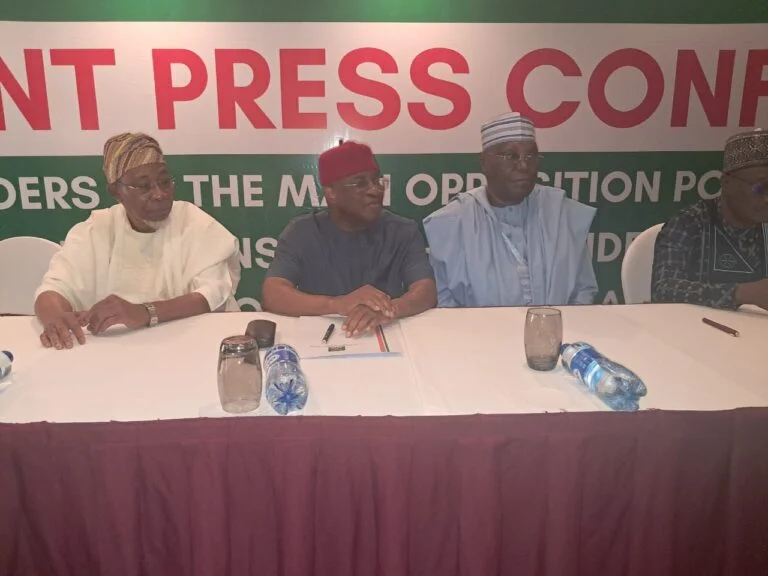
Leaders of the African Democratic Congress and the New Nigeria Peoples Party on Thursday in Abuja asked the National Assembly to begin a new amendment process for the Electoral Act 2026.
CLICK THE LINK TO READ FULL LIST
CLICK THE LINK TO READ FULL LIST
The call was made during a press conference held at the Transcorp Hilton, where several opposition figures gathered to present their concerns about the newly signed law.
Speaking on behalf of the group, NNPP National Chairman Ajuji Ahmed said lawmakers should remove provisions in the Act that they believe could weaken the electoral process.
According to him, parts of the law were passed and signed by President Bola Tinubu on February 18 without enough consideration of their long-term effect on elections, especially ahead of the 2027 general polls.
Under the Electoral Act 2022, political parties were allowed to choose candidates through direct primaries involving all registered members, indirect primaries conducted by delegates, or consensus agreed upon by party leaders.
However, the 2026 amendment limits parties to direct primaries and consensus only, removing the option of indirect primaries.
The new law also reduces the period for campaigns and timelines for party primaries. In addition, funding for the Independent National Electoral Commission will now be released six months before elections instead of twelve months as previously provided.
Ahmed said the opposition believes that some sections of the amended Act could affect transparency in elections.
He raised concerns about a clause in Section 60(3), which gives discretionary powers to presiding officers in cases where electronic transmission of results may face network issues. According to him, this could allow delays in uploading results from polling units.
Related News
He referred to past statements by former INEC Chairman Mahmood Yakubu, who had said that the Bimodal Voter Accreditation System operates offline and records a high success rate nationwide.
He also mentioned remarks credited to former INEC Commissioner Festus Okoye that internet access exists in all polling units.
Ahmed added that data from the Nigerian Communications Commission shows wide coverage of 2G networks and millions of internet and telephone subscribers across the country, which in his view weakens the argument of poor connectivity.
The opposition leaders also faulted the restriction of party primaries to only direct and consensus methods.
They argued that political parties should have the freedom to decide how to choose their candidates, including the option of indirect primaries.
According to them, regulating the mode of primaries interferes with the internal affairs of political parties.
Ahmed further stated that the group wants the National Assembly to begin another amendment process to remove what they described as objectionable provisions and ensure the law reflects the will of Nigerians.
Among those present at the briefing were former Senate President and ADC National Chairman David Mark, former Vice President Atiku Abubakar, Labour Party’s 2023 presidential candidate Peter Obi, former Rivers State Governor Rotimi Amaechi, NNPP chieftain Buba Galadima, ADC National Secretary Rauf Aregbesola, and other political stakeholders including Dino Melaye, Ralph Nwosu and Liyel Imoke.
The opposition leaders said they would continue to engage with lawmakers and the public as discussions around the Electoral Act continue.

Comments are closed.