

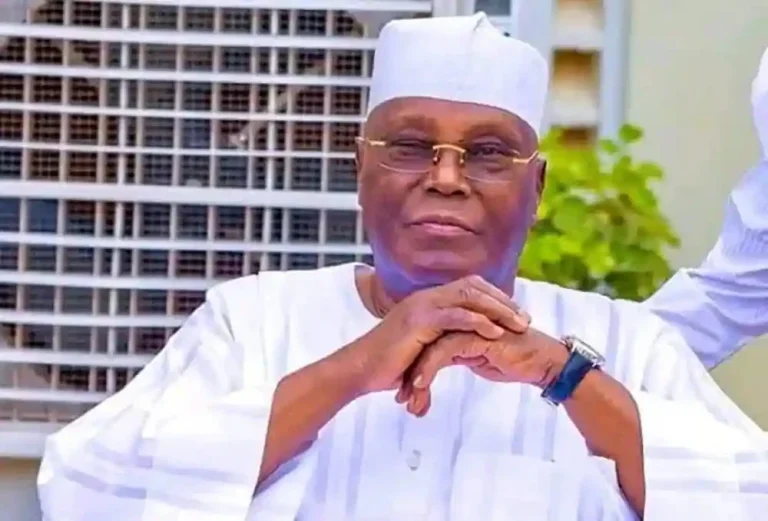
Former Vice President and African Democratic Congress (ADC) presidential candidate, Atiku Abubakar, has asked the Federal Government to explain the spending omitted from Nigeria’s recent budget documents after the International Monetary Fund (IMF) reported that public expenditure worth about two per cent of the country’s Gross Domestic Product (GDP) was not captured in the budget framework.

CLICK THE LINK TO READ FULL LIST

- Advertisement -

Sponsored Ads
In a statement released on Saturday through his Senior Special Assistant on Public Communication, Phrank Shaibu, Atiku said the IMF report raised serious concerns about transparency and accountability in the management of public funds. He argued that the issue goes beyond an accounting mistake and should be treated as a matter requiring urgent investigation.


- Advertisement -
The former vice president said every public expenditure must have passed through an approval process and questioned how such a large amount could be left out of official budget records. He maintained that Nigerians deserve a full explanation of how the money was authorised, spent and who benefited from it.
Atiku also linked the IMF report to the ongoing controversy surrounding the alleged Presidential Foreign Intervention Promotion Council (PFIPC), a body the Presidency has insisted does not exist. According to him, both issues point to deeper problems in the management of government institutions and public finances.
He questioned reports that the Federal Ministry of Health allegedly received only a small fraction of its approved budget while the controversial agency was said to have accessed a much larger amount. He described the situation as a reflection of misplaced priorities at a time critical sectors require adequate funding.
The ADC chieftain further called on the Secretary to the Government of the Federation, Senator George Akume, to explain how the alleged agency was recognised within government circles despite the Presidency’s denial that it was officially created.
Related News
He also referred to claims reportedly made by Adeniyi Adeyemi, the central figure in the PFIPC controversy, alleging that the dispute started after he refused to pay a percentage of a proposed take-off grant as a kickback. Atiku said the allegation was too serious to be ignored and should be subjected to an independent investigation.
According to him, if the allegations are found to be false, the government should clear the names of those involved through an open and transparent investigation. However, if they are confirmed, all officials connected to the matter should face the law, regardless of their positions.
Atiku said the controversy comes at a time Nigerians are struggling with the effects of fuel subsidy removal, rising electricity tariffs, inflation, multiple taxes and increasing public debt. He argued that citizens deserve openness from the government over the handling of public resources.
He called on the National Assembly, the Auditor-General of the Federation, the Public Accounts Committees of both chambers, the Economic and Financial Crimes Commission (EFCC) and the Independent Corrupt Practices and Other Related Offences Commission (ICPC) to investigate both the reported budget gap and the PFIPC controversy.
The former vice president maintained that the issue is about protecting public accountability rather than politics. He insisted that every public expenditure should be properly accounted for and any official found responsible for wrongdoing should be prosecuted.
The IMF had recently reported that Nigeria’s fiscal records contained gaps, noting that government spending equivalent to about two per cent of the country’s GDP was omitted from the budget documentation. The Fund recommended stronger fiscal transparency, improved budget reporting and tighter management of public finances to improve accountability.

Comments are closed.