

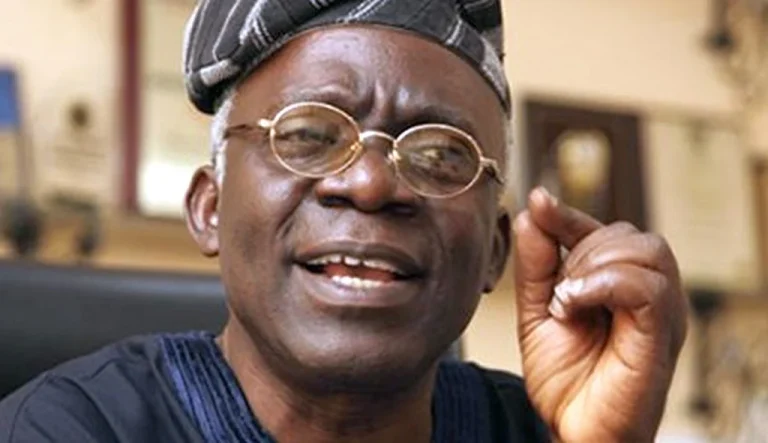
Human rights lawyer and Senior Advocate of Nigeria, Femi Falana, has called on the Economic and Financial Crimes Commission to investigate the alleged failure to account for N33.75bn meant for cash transfers to poor and vulnerable Nigerians.
CLICK THE LINK TO READ FULL LIST
CLICK THE LINK TO READ FULL LIST
Falana made the call on Sunday, September 6, 2026, following findings by the Auditor-General for the Federation, Shaakaa Chira, that the Federal Government could not provide enough evidence to show that the money reached genuine beneficiaries.
The funds were reportedly distributed in 2023 under the National Cash Transfer Programme to more than 3.29 million households across 35 states. The Auditor-General’s concerns were contained in the 2024 Annual Report on Non-Compliance and Internal Control Weaknesses in federal Ministries, Departments and Agencies.
Falana urged the EFCC to work with the Auditor-General’s office to trace the funds, recover any money found to have been misused and prosecute public officials found responsible after proper investigation.
He said the inability to properly account for money meant for vulnerable Nigerians raised concerns about the management of the country’s social intervention programmes, particularly those designed to reduce poverty.
The senior lawyer also referred to the National Social Investment Programme Agency, which was created under the National Social Investment Programme Agency Act 2022. The agency is responsible for coordinating social investment programmes, maintaining beneficiary records and improving the systems used to transfer funds to Nigerians.
The programmes covered by the law include N-Power, the National Home-Grown School Feeding Programme, the National Cash Transfer Programme, the National Social Safety-Net Programme, the Government Enterprise and Empowerment Programme and grants for vulnerable groups.
Falana, however, said previous controversies involving officials responsible for social investment programmes showed the need for stronger checks on public funds.
He recalled the investigation of former Humanitarian Affairs Minister Sadiya Farouq by the EFCC over allegations involving more than N37.1bn. He also noted that a Federal Capital Territory High Court issued an arrest warrant against Farouq and former Permanent Secretary Bashir Alkali in April 2026 after repeated failures to appear for arraignment.
Related News
The lawyer also mentioned the case involving former Humanitarian Affairs Minister Betta Edu, who was suspended in January 2024 after a leaked memo instructed the Accountant-General of the Federation to transfer N585m in public intervention funds into a private account.
Former NSIPA Chief Executive Officer Halima Shehu was also suspended and questioned over alleged irregular movement of funds. Falana called on the EFCC to conclude its investigations into the cases involving Edu and Shehu and make the outcome known.
Following earlier concerns about the social investment programmes, the Federal Government introduced additional measures aimed at improving the identification of beneficiaries. These included linking beneficiary records with Bank Verification Numbers and National Identification Numbers to reduce the presence of fake or duplicate beneficiaries.
Falana said the latest audit findings showed that questions still remained over whether the measures were working effectively.
He also raised concerns about the planned implementation of a $3.05bn development package announced by President Bola Tinubu in July 2026 with support from the World Bank. The package is expected to support poverty reduction, human capital development and wider economic opportunities.
Falana urged the Federal Government to put strong monitoring systems in place before the funds are released and used. He proposed the creation of an independent oversight arrangement involving credible civil society organisations to monitor how the money is distributed to poor and vulnerable Nigerians.
He also claimed that the World Bank could withdraw the funds if adequate safeguards were not put in place to prevent misuse. That claim would require confirmation from the World Bank.
The latest development has renewed attention on the management of Nigeria’s social protection funds. The Auditor-General’s findings have also placed pressure on government agencies and anti-corruption bodies to establish what happened to the N33.75bn and determine whether the failure to provide records resulted from administrative problems, poor controls or possible financial wrongdoing.
Falana’s call for an investigation comes as the Federal Government continues efforts to expand social protection programmes and improve the delivery of financial assistance to Nigerians facing economic hardship.

Comments are closed.