

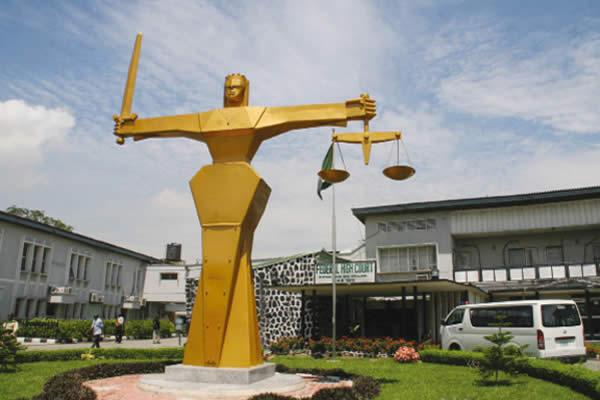
The Federal High Court in Abuja on Thursday granted the Independent Corrupt Practices and Other Related Offences Commission permission to access and examine electronic devices recovered from the residence of former Kaduna State Governor, Nasir El-Rufai.
CLICK THE LINK TO READ FULL LIST
CLICK THE LINK TO READ FULL LIST
The order was issued by Justice Joyce Abdulmalik after the anti-graft agency filed an ex parte application seeking approval to inspect the devices as part of an ongoing investigation.
The request was presented to the court by counsel to the commission, Osuobeni Akponimisingha, who asked the court to allow investigators to open and review the contents of the devices. The lawyer told the court that the items were recovered during a search carried out at the former governor’s Abuja home and were believed to contain information needed for the investigation.
After considering the application, the judge granted the request and permitted the commission to carry out forensic examination and extract data from the devices. The court order allows the investigators to check different types of information stored on the devices, including public records, WhatsApp chats, text messages, photographs, call logs and other digital materials.
Among the items listed for examination are several storage devices and mobile phones. The list includes a Sony HD-EGS storage device, a 1TB Transcend storage device, a Toshiba storage device, a Samsung mobile phone, a Nokia phone identified as N958GB, a Blackberry phone and a Google IDEOS phone.
Other devices include a Samsung storage device marked SPO802N, a Remarkable tablet, an Apple MacBook Pro laptop, a Seagate FreeAgent Desk external drive, a ZTE mobile phone, ten flash drives and a Microcell memory card.
The case, marked FHC/ABJ/CS/499/2026, lists the Federal Republic of Nigeria as the applicant and Nasir Ahmad El-Rufai as the respondent. The court ruled that the anti-corruption agency has the right to review items recovered during an investigation for forensic purposes.
Meanwhile, the former governor has filed another case before the same court challenging the search carried out at his Abuja residence. In the suit, he is seeking damages and claiming that the search violated his constitutional rights.
In the application filed through his lawyer, Oluwole Iyamu (SAN), El-Rufai asked the court to declare that the search conducted at his residence located at House 12, Mambilla Street, Aso Drive, Abuja on February 19 was unlawful.
Related News
He argued that the operation carried out by officers of the ICPC and the police violated his rights to dignity, personal liberty, fair hearing and privacy as provided under the Constitution.
He also asked the court to rule that any evidence obtained from the search should not be used against him in any legal proceeding. The former governor further requested an order directing the authorities to return all items taken from his residence along with a full inventory.
In addition, he is seeking N1bn as damages over the alleged violation of his rights.
In response, the ICPC filed a counter-affidavit stating that its actions were based on a petition submitted against the former governor. The agency said the petition led to an investigation, which eventually resulted in the search of his home.
According to the commission, its officers carried out the operation with a valid search warrant issued on February 18 and executed the following day. The agency said the search took place between 1:37pm and 3:56pm and was conducted at the residence in Abuja.
The commission also told the court that its operatives were accompanied by officers of the Nigeria Police Force during the search. It added that members of El-Rufai’s family, including his wife Hadiza El-Rufai and his son Mohammed El-Rufai, were present when the operation was carried out.
The police also filed a separate response supporting the action taken by investigators. In an affidavit sworn to by Inspector Ewa Anthony, the police stated that they have the legal responsibility to detect crimes, investigate suspects and prosecute offenders.
The police maintained that the search at the former governor’s residence followed a lawful process and was conducted under a valid search warrant issued by a competent court. They also told the court that all procedures required by law were followed during the operation.
The police further argued that the suit filed by the former governor was an attempt to stop the investigation and possible prosecution. They asked the court to dismiss the case in its entirety.

Comments are closed.